วันจันทร์ที่ 10 พฤศจิกายน พ.ศ. 2551

Japanese Cuisine

Tempura, sukiyaki, sashimi, sushi – even the words used to describe the most basic of Japanese dishes are exotic and beautiful...So popular is it that the Rice Bowl has even made its way into the world of Western convenience foods alongside ramen noodles....

Japanese Cuisine


Tempura, sukiyaki, sashimi, sushi – even the words used to describe the most basic of Japanese dishes are exotic and beautiful. Japanese cuisine is easily one of the healthiest in the world, with its concentration on fresh fish, seafood, rice and vegetables. The pungent sauces and delicate flavors of fresh foods complement each other beautifully, and the methods of presentation turn even simple meals into beautiful events.

The Japanese have easily a dozen different names for rice, depending on how it is prepared and what it is served with. The most common meal is a rice bowl, a bowl of white rice served with various toppings or ingredients mixed in. So popular is it that the Rice Bowl has even made its way into the world of Western convenience foods alongside ramen noodles. Domburi is a bowl of rice topped with another food: domburi tendon, for instance, is rice topped with tempura and domburi gyudon is rice topped with beef. The Japanese adopted fried rice from the Chinese, and a century ago, when curry was first introduced, developed Kare Raisu, curry rice. It is now such a popular dish that there are many fast-food restaurants that serves several versions of it in take-away bowls.

Besides white rice served as a side dish, Japanese cuisine also features onigiri – rice balls wrapped in seaweed, often with a ‘surprise’ in the middle, and kayu, a thin gruel made of rice that resembles oatmeal.

As an island nation, it’s not surprising that seafood is featured in Japanese cuisine. Sushi and sashimi both are raw fish and seafood with various spices. Impeccably fresh fish is the secret to wonderful sashimi and sushi, served with wasabi and soya sauce. The Japanese love of beauty and simplicity turns slices and chunks of raw fish into miniature works of art. Fish sliced so thin that it’s transparent may be arranged on a platter in a delicate fan that alternates pink-fleshed salmon with paler slices of fish. Sushi is typically arranged to best display the colors and textures to their best advantage, turning the platter and plate into palettes for the artistry of the chef.

Traditionally, meat plays a minor role in the Japanese diet, though it has been taking a larger and larger role over the past fifty years as Japan becomes more westernized. Beef, chicken and pork may be served with several meals a week now. One of the more popular meat dishes is ‘yakitori’ – chicken grilled on a skewer and served with sauce. A typical quick lunch might include a skewer of yakitori and a rice bowl with sushi sauce.

In an interesting twist, Japan has imported dishes from other cuisines and ‘Japanized’ them, adopting them as part of their own cuisines. Korokke, for instance, are croquettes adopted from those introduced by the English last century. In Japan, the most common filling is a mixture of mashed potatoes and minced meat. Other Soshoyu – western dishes that have made their way into Japanese everyday cuisine include ‘omuraisu’, a rice omelet, and hambagau, the Japanized version of an American hamburger.

By Expert Author: Sunil Sharma
Article Source: http://www.articlesphere.com/

Old-Fashioned Tomatoes

In midsummer he bought a whole crate of tomatoes. Luscious, red, ripe tomatoes. They sat in the cellar way for two days, and each time Patsy and I passed them our mouths watered...

Old-Fashioned Tomatoes

Raw vegetables are dangerous and must be thoroughly fried, steamed, and boiled into submission. So thought our ancestors. The original sin of a recalcitrant vegetable was of course lessened by heat, but the conscientious nineteenth-century cook continued to boil it long after it had sagged into a jelly-like mass, just in case some evil remained.

In the nineteenth century an hour’s cooking barely sufficed for cabbage and for corn on the cob. They did not fix broccoli at all, and I can understand why. I have tried to imagine broccoli after an hour of cooking, but the mind rarest back and refuses even to approach the sheer horror.

Which reminds me of an event in the summer of 1956, when my classmate Patsy Sutherland and I lived with Grandpa Hess while we went to business college in Missoula, Montana. Grandpa was a crusty old widower, set in his own way of housekeeping, but he tried to be gracious. In midsummer he bought a whole crate of tomatoes. Luscious, red, ripe tomatoes. They sat in the cellar way for two days, and each time Patsy and I passed them our mouths watered. Each evening we thought he’d invite us to have a tomato or two, but he didn’t. When we arrived home on the third evening, he said, “Girls! I fixed the tomatoes today. Help yourselves!”

He had stewed every last one of them.

Some of those old tomato recipes are good, though. The originator of Tomatoes Maryland probably had an old-fashioned wood stove that could gently simmer something all afternoon on a back burner or in the oven. Which means this was most likely a fall or winter dish rather than a summer one, as people let the cook stove fire go out on summer afternoons.

TOMATOES MARYLAND

Break into bits 2 slices of stale bread. Add to 4 cups canned or fresh tomatoes, peeled and quartered, with half an onion, chopped, and about 2/3 cup brown sugar. Salt lightly.

Bring the mixture to a boil and simmer gently for 3 hours, stirring occasionally.

My notes say, “It does need three hours to cook, even with the pan lid off most of the time. Perhaps some of the thin tomato juices could be poured off at the beginning, shortening the cooking time.”

Tomatoes Maryland is the kind of sweet side dish American cooks like to serve with chicken or pork. I was going to say, “Cooks from regions other than the Northeast.” Then I remembered applesauce with pork, cranberry sauce with turkey, mint jelly with lamb, and baked beans with salt pork. Not to mention pancakes and syrup with sausages cuddled up close. And mincemeat pie, that ultimate mixture of meat and sweet. (And, yes, real mincemeat, as opposed to a packaged mix, does contain meat.)

I will add that some people of Grandpa’s generation did eat diced raw garden tomatoes for breakfast, just as one would eat strawberries, with sugar and cream. You see, it was safe to eat them raw with sugar and cream, because the tomatoes then ceased to be a vegetable and became a fruit.

And actually those old-time breakfasters were right. Fresh vine-ripened tomatoes are good with sugar and cream. Let’s face it, most things are good with sugar and cream. And of course tomatoes really are a fruit.

By Expert Author: Mohan Mittal
Article Source: http://www.articlesphere.com/

Preparing Lobster Tails

Preparing Lobster Tails**lobster tails might start off a fresh or frozen,Boiling Lobster Tails..Cooking Lobster Tails in the Oven...Cooking Lobster Tails On The Grill...

Preparing Lobster Tails


Lobster, once the food of poor farmers, is now considered a special treat for many. Although some people prefer the meaty claws, I think that lobster tails are the best tasting part of this delicious creature. A great meal of lobster tails might seem like a gourmet feast to your guests, but they are actually quite easy to prepare. Add a little sprig of garnish and a fancy side dish and you’re sure to impress even your mother in law.

Your lobster tails might start off a fresh or frozen, being in New England, fresh lobster is easy to come by but frozen might be all you can get in some parts of the country and in the off season. If your lobster tails are frozen, you need to thaw them out (you can cook them frozen but they will not be as tender). Put them in the fridge for 10 hours or so or thaw them in the microwave on defrost – be very careful if you choose this method as you don’t want them to start cooking in the microwave.

After they are thawed, remove the meat from the shell by cutting open the back of the shell – split it down the middle and open it up to reveal the meat. Lift the meat out – you can leave the fan part of the tail on for show or not. Remove the vein.

Boiling Lobster Tails


Boil a pot of water large enough for all the tails to float in, add 1 tsp salt for each quart of water. Drop the tails in the boiling water and cook for about 1 minute per oz thawed (so 10 0z of tails needs to cook for 10 minutes). If you are cooking a lot of tails, add a minute or two on to the total time.

Cooking Lobster Tails in the Oven


Lobster tails can be baked or broiled in the oven. To cook thawed lobster in the oven, set the oven to 400 degrees F. Brush the tails with butter and bake for 8 to 10 minutes. If broiling, place the tails 4 or 5 inches from the heat and broil for 2 – 5 minutes. When broiling keep a very close eye on them so that they don’t burn on the tops.

Cooking Lobster Tails On The Grill


Oil the grill to keep the lobsters from sticking. Put the grill on medium heat. Brush the lobster tails with butter and place on the grill. Make sure that the tails do not burn – if there are any flames on the grill move the lobster away from it. Grill on each side for 4-5 minutes.

Take care not to overcook your lobster or it will be rubbery and tasteless. Lobster is cooked when it is no longer transparent.

By Expert Author: Vipull Bhagta
Article Source: http://www.articlesphere.com/

The Lowdown On Barbeque

The Lowdown On Barbeque

Barbeque, in the southern and Midwest parts of the United States, consists of slow-cooking meat over indirect heat. Chicken, beef, pork, sausage, ham, and ribs can all be barbequed - even mutton is sometimes barbequed, at least in Kentucky. With so many ways to make so many dishes, the perfect way to make barbequed meat can be a regional "bone" of contention.

In Memphis, Tennessee, barbeque is almost a religion. Barbeque ribs - most often pork, are cooked for long hours, until the meat is so tender that it is ready to fall off the bone. The city bills itself as the pork barbeque capital of the world, and has over one hundred barbeque restraints to back up that claim, many of whom participate in the annual pork cook off that is listen the Guinness Book of World Records as the largest pork barbeque contest anywhere.

The contest, part of the celebration called "Memphis in May", draws some 90,000 cooks and spectators. Competitors come from fifty smaller cook offs sponsored by the main contest. It even runs a series of training seminars for potential barbeque judges. Good barbeque, they say, is all about being tender, without being too mushy, and being smoky, without being overpowering.

Ribs commonly come "wet," that is, with barbeque sauce of some kind, usually mild and sweet in Memphis and basted on before and after cooking, or "dry," with a dry rub of herbs and spices that is applied during or right after cooking. Regardless of which style is favored, the taste of the meat should come through - this is what separates good barbeque from something lathered with barbeque sauce and put in the oven for a few hours.

In Missouri, there are not one, but two predominant styles of barbeque, both of which favor beef, which is not surprising given the history of both Kansas City and St. Louis as "cattle towns." They share a tomato-based sauce that is added after cooking, and can be replicated by mixing ketchup, brown sugar, mustard, and Worcestershire sauce. Interestingly, Missouri’s Ozarks are the source of almost half of the charcoal briquettes produced in the United States.

Kansas City, like Memphis, has a large number of barbeque restaurants and hosts several annual competitions. However, it is particularly famous for its sauces, which are thick, rich, tangy, and spicy. The sauce is based on during the last few moments of cooking, and more can be added thereafter. Dry rub, too, is common on Kansas City style barbeque.

In St. Louis style barbeque, ribs are the flagship dish. These famous spare ribs are a rack of ribs with the chine bone and brisket bone removed. They are cooked with a sauce that is less vinegary, tangier and thinner than its cross-state equivalent, closer, in fact, to that served in Memphis.

Whether sweet or spicy, dry or wet, slow cooked or grilled over an open flame, barbeque is one of the most diverse of all American foods, and one to which many cities lay claim. Each has its own unique character, so get some bread and crackers, or some Cole slaw, or even beans, (all traditional barbeque side dishes) and give them a try.

By Expert Author: Tarsem Singh
Article Source: http://www.articlesphere.com/

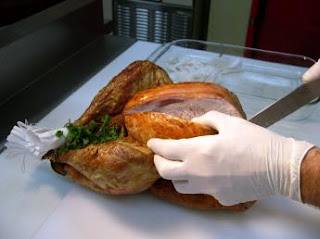
How to Carve a Turkey?

a turkey carving expert,Leave the turkey to sit 20-30 minutes after roasting and before carving...transfer the turkey onto a cutting board; Remove the Leg: Slicing the Drumstick (Leg) Meat: Slicing the Thigh Meat: When slicing thigh meat, Slicing the Breast Meat: ....

How to Carve a Turkey?


To someone who is just learning to cook, this topic may seem like one of the hardest meals you will ever have to prepare. Needless to say, if you’re having a turkey there’s usually company involved which means a number of hungry people are relying on you to prepare a great meal. This can be very intimidating. Luckily we have all the information you need, in order to ensure a great meal for you, your friends and your family.

In order to successfully carve a turkey, you will need to have the following pieces of equipment:


• One warm serving platter
• A pair of kitchen scissors
• An electric knife or a large slicing knife (you may want to choose a manual knife since they provide more control than electric ones)
• A small carving knife or fork for arranging and serving the meat

Now that you have the equipment you need to carve the turkey, follow these steps in order to become a turkey carving expert:


1. Leave the turkey to sit 20-30 minutes after roasting and before carving. This will make the meat moister and easier to cut.

2. After the turkey has sat for the time indicated above, transfer the turkey onto a cutting board; this is where you will begin carving the turkey.

3. Remove the Leg: To do this, hold the drumstick firmly with your fingers and gently pull the meat away from the body of the turkey. While doing this, cut through the skin between the leg and the body. Next, cut through the joint joining the leg to the backbone. Then separate the drumstick and thigh by cutting downwards through the joint, until the knife hits the cutting board.

4. Slicing the Drumstick (Leg) Meat: Once you have detached the leg from the rest of the body, you will want to slice the meat. Hold the drumstick in an upright position and turn the drumstick in a circular motion while cutting downwards. This will produce tasty slices of meat which are approximately equal size.

5. Slicing the Thigh Meat: When slicing thigh meat, you want to hold it close to the plate and secure it so it does not move. For best results when cutting thigh meat, make sure your knife is parallel to the bone and cut downwards towards the plate in slow, steady motions.

6. Slicing the Breast Meat: Make a deep cut into the breast of the turkey towards the body frame, as close to the wing as you can. Starting at the front of the turkey (about halfway up the breast) start cutting downwards, parallel to the cut you made to the wing. Only cut enough meat as you think necessary for the amount of people. Uncut meat will stay fresher longer.

7. Serve the Turkey: place all the slices of meat in an attractive manner on a large platter and serve to your guests.

* Note: Remove stuffing from the turkey either by taking it out of the hole made where the leg was removed or by making a new hole in the neck and taking it out from there.

By Expert Author: Annaya Rana
Article Source: http://www.articlesphere.com/

Culinary Traditions Of Cuba

The East Caribbean island of Cuba has a rich cultural heritage from which have arisen culinary traditions ***A typical sofrito is made of green pepper, onion, garlic, oregano and black pepper fried in olive oil until the pepper,...

Culinary Traditions Of Cuba

The East Caribbean island of Cuba has a rich cultural heritage from which have arisen culinary traditions that are as vibrant and varied as the variety of cultures that have contributed to the development of this distinct and delicious cuisine. In addition to the ancient influence of the native peoples of Cuba, the Spaniards brought their own culinary styles, tinged by those of the Moors who held huge parts of Spain for centuries. The slaves that were brought from Africa made significant culinary and cultural contributions, with other culinary traditions being brought to the island with the French colonists fleeing uprisings in Haiti.

As these various influences came together, a distinctly Cuban flavor and style evolved, which is reminiscent of country peasant styles of cooking by oral tradition and eye, rather than relying on specific measurements and the creation of dishes that tend towards the simple and hearty, and that can be left on their own to simmer. Fussy, heavy sauces are unusual and deep-frying is simply not a favored cooking method. The island nation, naturally, uses a great deal of seafood in its cuisine, which encourages the use of simple cooking techniques and spicing that is meant to enhance, not smother, natural flavors.

The most common spices used in Cuban cuisine are garlic, cumin, oregano and bay or laurel leaves. Sofrito is also popular, and used in a wide range of dishes, from those of beans to those of meats to those that are made from a base of tomato sauce. A typical sofrito is made of green pepper, onion, garlic, oregano and black pepper fried in olive oil until the pepper, onion and garlic are soft and translucent and the flavors blend to perfection.

The dense, nutritious, energy producing vegetables commonly used belie the African and native peoples’ influence on the cuisine of Cuba. Yuca, malanga, boniato, and plantano are among these, and are often simmered together with complementary vegetables and served simply, drizzled with olive oil and sprinkled with chopped fresh onion – a satisfying, strengthening and simple dish for a hard working people.

Meats are often prepared using island flavored marinades of that use lime juice or the juice of a sour variety of the orange as a base. Then, the meats are roasted or simmered very slowly with spices, often for hours. Beans and rice are an essential part of most meals, with black beans being well known as a Cuban specialty.

Cuban cuisine is also notable for its baked goods, which include a variety of turnovers. Some are filled with spiced meats and other types feature a particularly Cuban blend of cream cheese and guava paste. Flan is among Cuba’s most beloved dessert items.

In Cuban cuisine, the subtle flavors of healthy foods are enhanced by cooking and spicing methods designed to bring out the best in each component of a dish. The culinary traditions of Cuba are a delight to the tongue, naturally, but they also offer a fascinating glimpse into a culture that has brought together many varied elements to create a cohesive whole.

By Expert Author: Bhavna Sharma
Article Source: http://www.articlesphere.com/

Garlic: A Quick Guide

garlic will soften and begin to sprout, which turns the garlic bitter. To store fresh garlic, keep it in a dark, cool place, such as the basement...To peel a clove of garlic, place it on a cutting board, and put the flat of the blade of the knife against it....

Garlic: A Quick Guide


Garlic, there's nothing like the smell of garlic. It's great in soups and sauces, roasted with meats or on its own, and it's wonderful mixed with butter and slathered on bread and then baked.

The scientific name for garlic is Allium Sativum. It is related to the lily and the onion. Although related to the onion, and having a flavor that very slightly resembles that of an onion, garlic does not bring tears to the eyes when chopped.

When buying fresh garlic, be sure that the head feels very firm when you squeeze it. Over time, garlic will soften and begin to sprout, which turns the garlic bitter. To store fresh garlic, keep it in a dark, cool place, such as the basement. Do not refrigerate or freeze the garlic, as it will begin to loose its taste.

To peel a clove of garlic, place it on a cutting board, and put the flat of the blade of the knife against it. Press down on the other side of the blade with the heel of your hand, flattening the garlic slightly. The skin will come right off.

The strong flavor and odor of garlic come from sulfur compounds within the cells. The more cells that are broken, the stronger the flavor of the garlic will be. For the mildest flavor, just use a whole or slightly crushed clove of garlic. For a bit stronger flavor, slice or chop the garlic, and for the strongest flavor, mash the garlic into a paste.

Cooking garlic tames the strong flavor, and changes it in different ways, depending on how it's cooked. If using in a sauce, it can be sweated or saut?ed. In sweating the garlic, it is first chopped finely, and then added to a cold pan with some oil, it is then gently heated, causing the oil to become infused with the garlic flavor. To saut? garlic, heat the oil in the pan first, and then add the chopped garlic, stirring frequently, and being careful not to let the garlic burn and become bitter.

Roasting the garlic softens the flavor, and makes it soft and perfect for mixing with cream cheese to spread onto toast, or just spread on the toast itself.

To roast the garlic, take a whole head of garlic, and remove the papery outer skin. Place the garlic on a piece of aluminum foil, and drizzle with some olive oil. Loosely wrap the garlic in the foil, and place it into a 350 degree oven for 1 hour. Remove the garlic and let it cool. When cool enough to handle, separate the cloves of garlic, and squeeze each one. The flesh should pop right out. The roasted garlic is great mixed with cheese or potatoes, or on its own.

Don't be afraid to use garlic in your cooking. Garlic is flavorful, and healthful, and of course, it will keep those pesky vampires away.

By Expert Author: Singh H
Article Source: http://www.articlesphere.com/